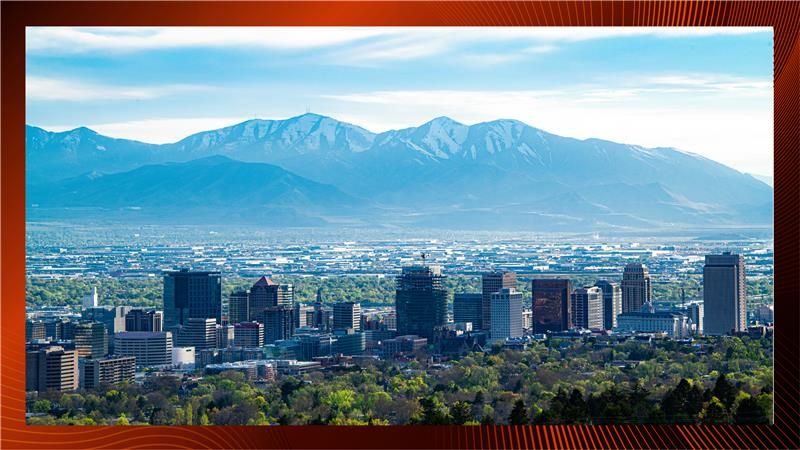
SLC

Salt Lake City places POWERGEN 2027 in one of the most relevant power markets in North America for the companies planning, building, operating and supplying the next generation of electricity infrastructure.

Across the Western U.S., utilities, independent power producers, EPCs and engineering firms, and major equipment OEMs are responding to the same pressures reshaping the industry: accelerating load growth, large new data center demand, tighter reliability requirements, generation replacement needs, transmission constraints, and the growing urgency to deliver new capacity on realistic timelines.

The Mountain West has become a real-world proving ground for the issues that matter most to POWERGEN’s audience: how to add dispatchable capacity, modernize existing fleets, integrate renewables and storage, serve large new loads, and move projects from planning to execution.


 

A Power Market in Rapid Expansion

Electricity demand across the Western grid is accelerating faster than utilities and market participants projected just a few years ago.

20%+
projected electricity demand growth across the Western grid this decade
166 GW
of new U.S. peak electricity demand expected within the next five years
90 GW
of projected demand from data centers alone this decade

U.S. electricity consumption is expected to reach record highs in 2026 and 2027, driven largely by  AI infrastructure, hyperscale data centers, advanced manufacturing, electrification and population growth.

For utilities, that means new urgency around reliability, capacity additions and infrastructure investment. For IPPs and developers, it means a larger pipeline of opportunities tied to bankable, executable projects. For EPCs and engineering firms, it means growing demand for partners who can help navigate siting, interconnection, design and delivery. For OEMs, it means a market increasingly focused on equipment availability, project readiness, performance and lifecycle value.

Salt Lake City Image

The Mountain West Is One of the Fastest-Growing Energy Regions 

The Interior West — including Utah, Arizona, Colorado, Nevada and New Mexico — is emerging as one of the fastest-growing electricity markets in the country. Utilities across the region are forecasting 50%+ electricity demand growth over the next decade.

Utilities such as Rocky Mountain Power (PacifiCorp) are already planning for significant load growth as hyperscale data center development accelerates across the West.

Utah Is Emerging as a Major Data Center Hub

Salt Lake City and the surrounding Utah region are rapidly becoming a destination for hyperscale data center development thanks to several structural advantages:

  • Reliable and scalable regional power resources
  • Strong transmission and distribution infrastructure
  • Strategic connectivity for western data networks
  • Available land supporting large hyperscale campuses
  • A cooler climate that supports efficient data center cooling

These advantages are fueling rapid expansion across the Salt Lake Valley.

699%
projected growth in regional data center capacity by 2030
1,200+ MW
of expected data center power capacity in the Salt Lake market
200–1,000 MW
required by a single hyperscale data center campus

Some proposed AI facilities could require gigawatt-scale electricity demand, placing Utah at the center of discussions around large-load interconnection, generation planning, and infrastructure investment.

Banner Image

A Region Balancing Fleet Transition and Reliability

The Mountain West is navigating many of the same pressures reshaping the broader U.S. power sector, including rising demand, fleet transition, reliability concerns and the need to bring new capacity online on practical timelines.

As coal assets retire or convert, utilities and developers across the region are making consequential decisions about replacement resources, renewable integration, fuel flexibility and long-term infrastructure planning. Projects like the Intermountain Power Project reflect the kinds of choices increasingly relevant to POWERGEN attendees, from hydrogen-ready gas generation to resource adequacy and system modernization.

Across the region, those pressures are driving investment in:

  • Dispatchable gas generation
  • Utility-scale renewables
  • Long-duration energy storage
  • Transmission expansion
  • Hydrogen-ready infrastructure

Where Power and Digital Infrastructure Converge

The presence of multiple hyperscale data center campuses within close proximity to Salt Lake City creates a unique opportunity for POWERGEN attendees to explore the intersection of power generation and digital infrastructure.

For utilities, IPPs, EPCs and major equipment suppliers, that means a front-row view into the challenges and opportunities tied to large-load growth: new generation needs, infrastructure readiness, interconnection pressure, reliability planning and faster project execution.

This regional ecosystem strengthens POWERGEN’s role as the event where the power generation industry and digital infrastructure leaders come together to address the future of electricity demand and the systems required to serve it.

SLC

Hosting POWERGEN 2027 in Salt Lake City puts the event at the center of one of the fastest-growing energy markets in the United States.

Power Projects Shaping the Mountain West Generation Buildout 

 The Mountain West is absorbing more new generation investment, driven by data center load growth, coal retirements and Western grid reliability pressure. The projects below represent where that capital is actually moving. 

Powering the AI & Data Center Boom 

The Stratos Project is a proposed off‑grid hyperscale data center campus in northern Utah capable of supporting up to 9 GW of on‑site natural gas generation. If developed as planned, it would rank among the largest behind‑the‑meter power deployments ever proposed in the United States.

Joule Capital Partners is developing a large data center campus in Millard County powered by a fleet of Caterpillar’s G3520K generator sets and support equipment, as well as 1.1 gigawatt-hours (GWh) of battery storage. Construction is expected to begin in 2026, reflecting the speed and modularity driving data center‑led power development.

Creekstone’s Delta Gigasite is a planned hyperscale data center campus adjacent to Intermountain Power, with long‑term capacity approaching 10 GW. The project would combine near-term gas, solar, and contracted capacity from the adjacent Intermountain Power Project with the evaluation of up to 2 GW of advanced nuclear.

Advanced Nuclear Moves From Concept to Construction 

The Brigham City initiative is a public‑private effort to build manufacturing, workforce training, and deployment capacity around Holtec’s SMR‑300 reactor. It represents a coordinated approach to establishing a regional advanced nuclear supply chain, not just a single plant.

TerraPower's Natrium project in Kemmerer is a 345 MW sodium-cooled fast reactor paired with molten salt energy storage to enable flexible output. Non-nuclear site work has been underway since June 2024, and the NRC issued its construction permit in March 2026. It is one of the most prominent U.S. demonstrations of advanced nuclear replacing retiring coal generation.

As part of its Delta Gigasite development, Creekstone Energy is evaluating advanced nuclear reactors, including SMRs, to support long‑term data center baseload demand. Commercial nuclear deployment is targeted for the 2030–2035 timeframe, pending feasibility and licensing outcomes.

 New Dispatchable Capacity 

IPP Renewed replaces 1,800 MW of retired coal generation with 840 MW of hydrogen‑capable combined‑cycle gas turbines at one of the West's most strategic power sites. Both units reached commercial operation in 2025.

Arizona Public Service’s Desert Sun project is a proposed two‑phase natural gas plant of up to 2,000 MW designed to support rapid load growth. The project introduces a subscription model in which large data center customers directly pay for new generation capacity.

SRP’s Marigold Energy Center is a proposed hybrid facility combining 675 MW of natural gas, 600 MW of solar, and 400 MW of battery storage at a single site south of Phoenix. The project illustrates how utilities are pairing dispatchable power with renewables to maximize system flexibility and infrastructure efficiency.

PacifiCorp’s 2025 IRP outlines more than 2,200 MW of new natural gas generation alongside long‑term solar and advanced nuclear development. As host utility for POWERGEN 2027, PacifiCorp's plan signals where major capital investment and procurement activity will focus across the Western grid.

Always‑On Clean Power 

Fervo Energy’s Cape Station is the world’s largest enhanced geothermal system under construction, with Phase I delivering 100 MW to the grid in 2026 and Phase II bringing an additional 400 MW online by 2028, with permits allowing expansion to 2 GW.